Deploy any robot to do anything.
nex-ON is the embodied OS — a robot-agnostic deployment platform that sits between an AI brain and a robot body. Perception, tooling and motion become modular capabilities an LLM composes on the fly, delivered as an edition built for your industry — Weld OS first. You direct it by talking.
What it takes to direct it.
Not what is under the hood — what an operator meets on day one. If any of these three is wrong, nothing else on this page matters.
Push-to-talk, in the words the trade already uses. No teach pendant and no CAD program.
Locked per session, so chatter across the shop floor in another language cannot hijack the arm.
Ask for any object in plain words. Nothing needs a per-class training run first.
One OS core. A purpose-built edition for every industry.
nex-ON is the horizontal layer. On top of it we build vertical editions — each carrying the vocabulary, tolerances, tooling and safety interlocks of a specific trade, so an operator in that trade can direct a robot in their own words. Every edition inherits the same brain, the same tool registry and the same safety model.
We proved the platform on the hardest near-term task. Weld OS finds the bare-metal seam in front of it, measures the part, rehearses the pass with the arc off, and welds it when you arm it — directed by voice, with no teach pendant and no CAD program.
- ▸Seam finding from a depth-and-image profile scan
- ▸Four weave patterns, specified the way welders specify them
- ▸Dry-first arc interlocks that never persist across a restart

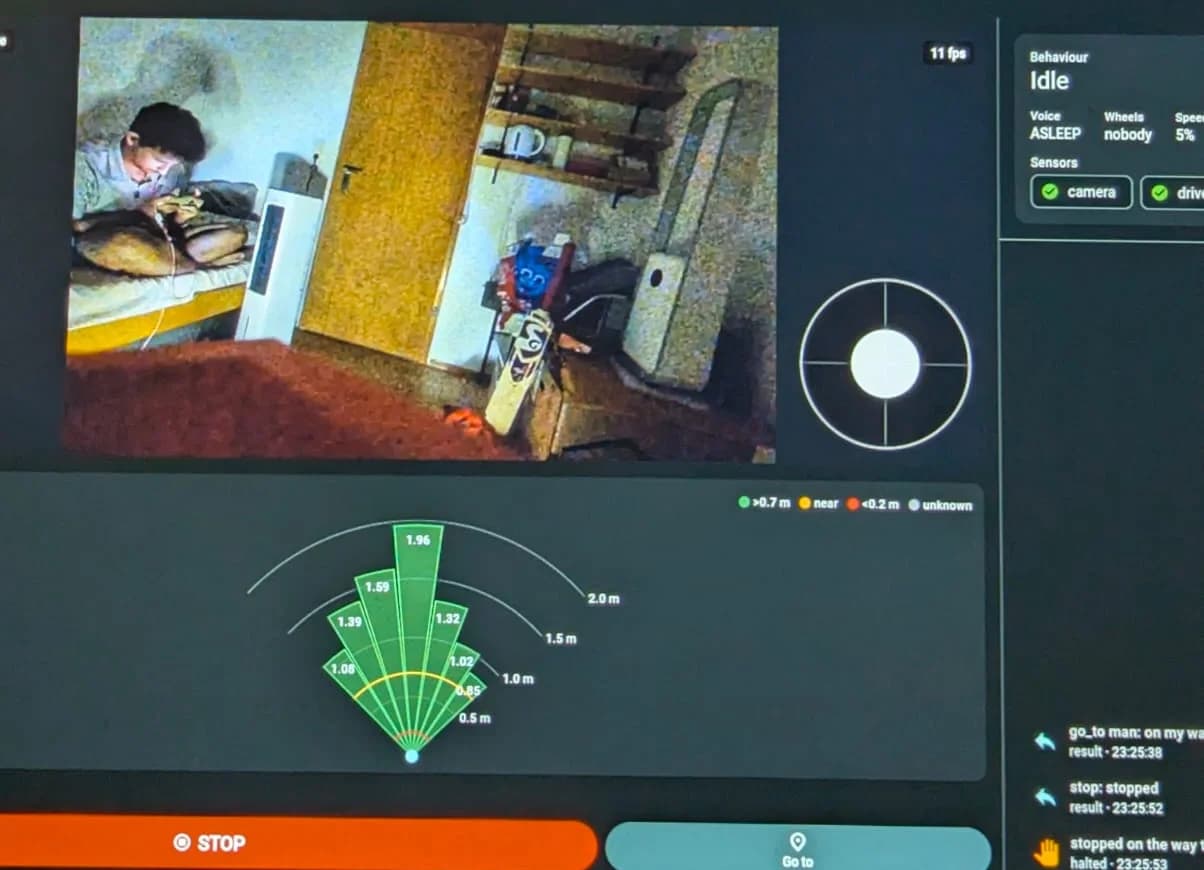
The same orchestration on a humanoid body: everyday tasks alongside people — fetching, handing over and tidying — directed conversationally by whoever is in the room.
Cutting, drilling, fitting and fastening across high-mix fabrication work — part identification, alignment and force-aware contact.
Precise, auditable handling for clinical and laboratory environments, where every action is logged and nothing acts unprompted.
Bring us the task your integrators quote in weeks. Editions start as a pilot on a robot you already own.
Robots are capable. Deploying them is the hard part.
Putting a robot to work still means a specialist hand-jogging a teach pendant waypoint by waypoint, or an engineer writing an offline CAD/CAM program for every new part. Both are slow, need scarce skilled labour, and break the moment reality sits a few millimetres off the model.
Days of integrator time per part.
It sees the part in front of it.
Perceive. Reason. Act. Narrate.
An LLM runs an agentic tool-calling loop. Mid-conversation it decides when to look through the camera, what to measure, where to move — then reports back out loud in a sentence or two.
Ask for any object in plain words — "metal tube", "flange". Depth-fused imagery returns length, width and distance in millimetres.
The brain picks the tools: detect, measure, find the seam, check reachability, plan the stroke. Discrete calls you can read — not an opaque policy.
Every dangerous action is dry by default. A live arc must be deliberately armed each session and never persists across restarts.
One brain. Modular tools. Any body.
Perception, tooling and control are interfaces rather than fixed implementations. Adding a robot or a skill means registering a tool — not rebuilding the system.
Everything below runs on a real arm right now.
An agentic tool-calling loop chooses when to look, when to move and when to act, then narrates the result in a sentence or two.
Push-to-talk recognition and streamed speech. Replies start speaking after the first sentence, so long answers still feel immediate.
English, Hindi or German — locked per session so background chatter in another language cannot hijack the robot. Optional barge-in.
Ask for any object in plain words with no per-class training. The detection backend is a swappable interface.
Image, aligned depth and camera intrinsics fuse into length, width and distance in millimetres — the physical size of the part.
Inside an operator-drawn area, a depth-and-image profile scan finds the joint, maps both endpoints into robot coordinates and traces it.
Dry-run rehearsal, deliberate arming of dangerous actions that never persists across restarts, per-axis motion locks, low default speeds.
Detect markers, dots and taped lines by colour, then move to or trace them — including shortest-path multi-target routes.
A calibrated camera-to-robot transform turns the pixel it sees into the exact 3D point to move to.
We proved the platform on the hardest near-term task: autonomous welding.
Welding demands everything at once — sub-millimetre perception, safe real-world actuation, and non-expert operability. Omnicron is Weld OS — nex-ON driving a collaborative arm: it finds the bare-metal seam inside an operator-drawn area, maps both endpoints into robot coordinates, and runs the stroke at a constant standoff. Weave patterns are specified the way welders specify them.


Everyone else is building the body or the reflexes.
nex-ON is the deployment platform that lets any body do any job.
Welding systems, seam trackers, no-code programming tools. They solve a single task on a single form factor.
Humanoids and robot foundation models: capital-intensive, hardware-heavy, often single-embodiment, and opaque at inference.
Works with robots that already exist, from many vendors. Interpretable tool calls with safety gates and dry runs instead of an opaque policy trained at scale.
A working platform, validated on the hardest first task.
- Voice orchestration, in and out, three languages
- Open-vocabulary vision with no per-class training
- Millimetre measurement from fused depth
- Seam detection, following and gated live welding
- Weave patterns and colour-guided pathing
- Hand-eye calibration and IK reachability checks
- The same orchestration on humanoids and AMRs
- Additional end-effectors and sensor classes
- Mixed-fleet task assignment
- First-party hardware — near-term roadmap, not today
The modularity is real in the codebase — swappable detector, tool-based capabilities, abstracted motion. The additional bodies are roadmap, and we say so.
The ones we get asked most.
Do you sell robots?
Not today. nex-ON is software — the layer between an AI brain and a robot body. We run on collaborative arms that already exist, from vendors our customers already buy. First-party hardware is on the near-term roadmap, not in front of you today.
Which robots does it support right now?
It is live on a Fairino collaborative arm via a vendored SDK, with linear and joint motion, IK reachability checks and torch-down orientation solving. Motion is abstracted behind an interface, which is what makes the next body an integration rather than a rebuild.
Is this a learned end-to-end policy?
No. The brain reasons, then calls discrete, inspectable tools with safety gates and dry runs between them. That is deliberately more interpretable and controllable than an opaque neural controller.
How is welding made safe?
Welding defaults to a dry pass: the motion is identical but nothing is energised. A live arc must be deliberately armed each session and never carries over a restart. Speeds default low, and any move can be reachability-checked before the arm moves.
What does a pilot look like?
We deploy on a robot you already have, calibrate camera to robot, and run your task conversationally — starting dry. You judge it on time-to-deploy against your current teach-pendant or CAD/CAM route.
What infrastructure do we need?
Python, a standard USB depth camera, a mic and speakers, and a computer to run it on. No training pipeline, no cloud dependency for motion.
Bring us a part. Talk to it.
We deploy nex-ON on a robot you already have, on a task you already run, and you direct it in plain language on day one.